|
The Etude Magazine. April, 1939
B. A. Rolfe is distinctly a self-made musician, in every sense of the word. Literally brought up from childhood in a circus band, his progress to Broadway, and his large variety of enterprises, make this one of the most colorful articles The Etude has ever presented.
Read More »
|
|
The Etude Magazine. April, 1939
I look upon the Philadelphia Symphony Orchestra under Leopold Stokowski and Eugene Ormandy as the greatest musical instrument of its type in the world. There has never been anything in the way of an orchestra so exquisitely perfect and responsive.
Read More »
|
|
The Etude Magazine. April, 1939
“Music has been aptly termed ‘the fourth essential,’ only food, clothing and shelter preceding music in importance in a well rounded and happy life. And to participate in a musical performance, even one of mediocre degree of excellence, is ever so much more enjoyable than merely to sit and listen. The progress or retrogression of a nation depends on its home life; and a musical home is a happy home.”
Read More »
|
|
The Etude Magazine. April, 1939
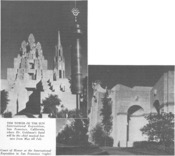
The band itself was largely to blame for its own downfall. The musicians felt that they were secure in their positions; and their chief interest, and in many cases also their only interest, was in the pay envelope. The result was that many of the bands were terrible.
Read More »
|
|
The Etude Magazine. April, 1939
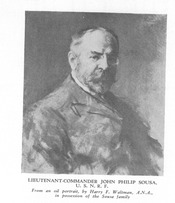
EDWARD VII and his son the Prince of Wales (later George V) were, according to the Court Calendar, to appear in a military ceremony to take place before St. James” Palace in the heart of London. As an American youth…
Read More »
|
The Etude Magazine. August, 1939
IGOR STRAVINSKY is announced as having been appointed as Charles Eliot Norton Professor of Poetry at Harvard University, for the 1939-1940 academic year. Though designated as a chair of poetry, this Professorship is awarded annually, without regard to nationality, to…
Read More »
|
The Etude Magazine. January, 1904
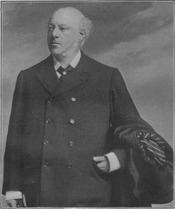
H. P. Danks, a composer whose songs were widely known and used a number of years ago, died in Philadelphia. November 20th, aged 79 years. He was the composer of “Silver Threads Among the Gold,” and “Don’t Be Angry With Me, Darling,” He wrote a great deal of church music.
Read More »
|
|
The Etude Magazine. January, 1904
“English is a good language to sing, no matter what is asserted to the contrary. Personally, I class English, next to Italian, as the best language for singing. But the worst of the matter is that so few speak it properly. Quite unfortunately the English do not study English diction, yet they should study it as they study spelling and grammar.”
Read More »
|
|
The Etude Magazine. October, 1900
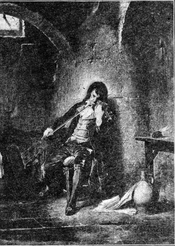
When Paganini paid his first visit to Paris, he was amazed (and perhaps not a little pleased) to be confronted at every turn by the most ludicrous caricatures of himself. But what particularly impressed him was a picture representing him in his lonely cell expiating his crime at the altar of his beloved art.
Read More »
|
The Etude Magazine. June, 1903
An Italian composer, Gallignani, director of the conservatory at Milan, has written a large choral work with the Latin title, “Quare” or “Wherefore.” The titles of the sections of the work are “Humanity,” “The Stoics,” “The Epicureans,” “Skeptics and Atheists,” “Mystic Chorus,” “Song of the Sun,” and “Invocation to Supreme Love.”
Read More »
|
The Etude Magazine. June, 1903
Art becomes national, it seems to me, only when it expresses the egotism of the race. There must be a subconscious certitude of being before there is the impulse to voice those sentiments which individualize a nation.
Read More »
|
|
The Etude Magazine. June, 1903
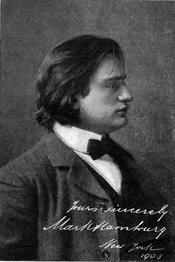
“A certain amount of nervous anxiety prior to appearing is really necessary to the securing of a good performance, but this phase of nervousness and stage-right, which is an unnecessary condition, are widely opposite. To my way of thinking, and speaking from experience, if one thoroughly knows a thing—and none should think of performing anything in public that he has not completely grown into—stage-fright is an entirely unnecessary condition.”
Read More »
|
The Etude Magazine. September, 1902
It can hardly be said that the clubs are getting ready for work, for as yet those who give the most active work and thought to the welfare of these organizations are resting up for the coming season. The growth of the musical-club fad, if so beneficial a function may be termed a fad, is nothing short of remarkable.
Read More »
|
The Etude Magazine. September, 1902
The composer is worse off than any other branch. If he writes the highest and best, he cannot publish, and he must teach or sing low to get a living. The music now published, however, is much better than was the case in the past, and there has been a great awakening and extraordinary change in the last fifteen years.
Read More »
|
The Etude Magazine. September, 1902
The question received relating to accompanying singers was so pertinent to present conditions that I have made an extended allusion to it in the article heading this department. Ida H.—The Baritone, when singing from a treble score, pitches his voice…
Read More »
|
The Etude Magazine. September, 1902
Prof. E. W. Scripture contributes an article entitled “How the Voice Looks” to a recent number of the Century. Professor Scripture is director of the Psychological Laboratory of Yale University, and if his views are accepted there promises to be…
Read More »
|
The Etude Magazine. September, 1902
W. J. Henderson clears up some of the fog of adulation that exists around the present-day opera-singers. He writes in his department of the New York Times: The unthinking worship of the opera-singer has its origin in the supposition that…
Read More »
|
The Etude Magazine. September, 1902
This question was asked me some time ago by a pupil who for years had been singing with a very tightly constricted throat, so much so, that the quality was very harsh and poor, and there was very little power….
Read More »
|
June, 1903
"A certain amount of nervous anxiety prior to appearing is really necessary to the securing of a good performance, but this phase of nervousness and stage-right, which is an unnecessary condition, are widely opposite. To my way of thinking, and speaking from experience, if one thoroughly knows a thing--and none should think of performing anything in public that he has not completely grown into--stage-fright is an entirely unnecessary condition."
Read More »
|
|
August, 1891
It is said that one of the most eminent lady American pianists (Mme. Rive King) owes her great command of the resources of the keyboard to a somewhat strange and rigorous style of practice. The system seems to be also...
Read More »
|
• Paderewski and Liszt. -
July, 1893
• On the Use of the Damper Pedal. -
July, 1893
• Basic Principles in Pianoforte Playing, Part IV - JOSEF LHEVINNE -
January, 1924
• Praise of a Poor Piano - A Paradox - By Eugenio Pirani -
January, 1924
• Basic Principles in Pianoforte Playing, Part III - Josef Lhévinne -
December, 1923
• Basic Principles in Pianoforte Playing - Josef Lhévinne -
November, 1923
• Should Piano Playing Undergo a Radical Reform? - Vladimir de Pachmann -
December, 1923
• Liszt as Pianist and Piano-Composer. -
May, 1902
|
July, 1893
Poetic, Schumann ever was. Poetic by nature and by culture. Poetic in his work both as composer and as criticiser of the works of others. Poetic in his every thought--every idea. And this poetic spirit he infused into the music of his time, and cultivated it wherever and in whomsoever he found it. And it is for this that I have called him "Robert Schumann--Poet," and it is as poet that I shall here regard him.
Read More »
|
|
January, 1924
The underlying trait of my father's character was a lofty artistic earnestness. Along with this, however, there poured forth an illuminating humor and a sunny happiness which, notwithstanding the difficult life situations and the disappointments, rarely resolved into satire or irony.
Read More »
|
• The Writing of the “Requiem.” -
December, 1898
• Notes on the Works of Some Living Composers -
July, 1893
• Liszt as Pianist and Piano-Composer. -
May, 1902
• Liszt, the Musical Liberal -
May, 1902
• Liszt as a Musical Influence. -
May, 1902
• Victorious Liszt. -
May, 1902
• Robert Schumann on Liszt’s Playing. -
May, 1902
• Transcriptions for the Piano by Franz Liszt. -
May, 1902
|
April, 1939
The band itself was largely to blame for its own downfall. The musicians felt that they were secure in their positions; and their chief interest, and in many cases also their only interest, was in the pay envelope. The result was that many of the bands were terrible.
Read More »
|
|
July, 1910
Musical History is really an extremely interesting subject when the matter is presented in a thoroughly understandable manner. The object of the work of which the following is one of forty story lessons is to make the subject of musical history accessible to the beginner and at the same time inviting and inspiring. The work is designed for adults as well as young people, the only distinction being its simplicity and popular style.
Read More »
|
• The Polka. -
August, 1891
• Finck’s New Biography of Wagner. -
July, 1893
• The Development of Music in the South During the Past Twenty Years. -
July, 1901
• The Humor of Richard Wagner - Written Expressly for The Etude by the Son of the Great Master - SIEGFRIED WAGNER -
January, 1924
• Usefulness Of Some Recent Composition - JAROSLAW DE ZIELINSKI. -
July, 1897
• Famous Musical Women of the Past. -
November, 1918
• Dr. William Mason - The Nestor of American Musicians. -
October, 1901
• Methods and Customs of the Paris Conservatoire -
February, 1910
|
Selected content from "The Etude" Magazine
|
|

 .
Selected Etude Magazine Stories
.
Selected Etude Magazine Stories